A case study from my consulting practice.
A founder reached out after reading my profile. He runs a bootstrapped LinkedIn personal branding agency. Three clients, a co-founder who builds systems well but does not enjoy running them, and a nagging sense that something was off. He did not have the language for it yet. He was looking for an operator and did not know that was the word.
He thought his problem was growth.
For months he had been writing the content and running the outreach himself. When money is tight, that feels responsible. Push the revenue personally.
The unlock came two months before our call, when he noticed he was operating like a freelancer instead of a founder.
Freelancer thinking asks: how do I personally get better at content and outreach?
Founder thinking asks: who should own content and outreach so I can focus on building the business?
That one reframe changed how he spent his time. He stopped optimising his own output and started testing acquisition channels, roughly Rs 45k deployed deliberately rather than brute-forced through hustle. Two retainers closed. He had proof that intentional capital beats founder grind.
And then growth exposed the next bottleneck.
The problem underneath the problem
Operations were breaking down. Deadlines slipping. Follow-ups missed. Clients delaying inputs while he firefought instead of building.
The strange part: this was happening with everything supposedly in place. The service was deliberately simple. Processes were defined. Notion dashboards existed. Roles were understood on paper.
The machine existed. Nobody was running it every day.
So I asked him to walk me through onboarding step by step, as if I were the client. Then: who owns follow-ups when a client goes quiet? Who tracks deadlines end to end? Who keeps writers, clients, and schedules aligned? Is anyone accountable for nothing slipping, or is that responsibility quietly spread across everyone, which means no one?
There was no owner.
This is the part founders miss. It looked like a complexity problem, the kind you solve with a better tool or a sharper process. It was an accountability problem. The co-founder builds systems and does not want to run daily execution. The founder is a strategist and does not want to chase repetitive tasks. Freelancers optimise for output, not operational discipline. And tools never replace ownership.
What I told him to do
Stop expecting the founder or the builder to become the operator. They will not, and they should not.
Bring in one person whose entire job is the boring, repetitive, crucial work: run the system daily, enforce follow-ups, track deliverables per client, nudge clients without hesitation, make sure nothing falls through the cracks.
At his stage I leaned toward one person owning operations A-to-Z rather than splitting ownership per account. Simpler, and it scales. A full-time junior project manager at Rs 25k to Rs 30k is a stronger foundation than a distracted freelancer who erodes discipline. And I was clear about the timeline. Operations do not stabilise in a week. Processes reduce thinking, not work. Expect six to twelve months to build the muscle.
That was the whole diagnosis. One free conversation. One clear recommendation.
What happened next
The recommendation sat for a while.
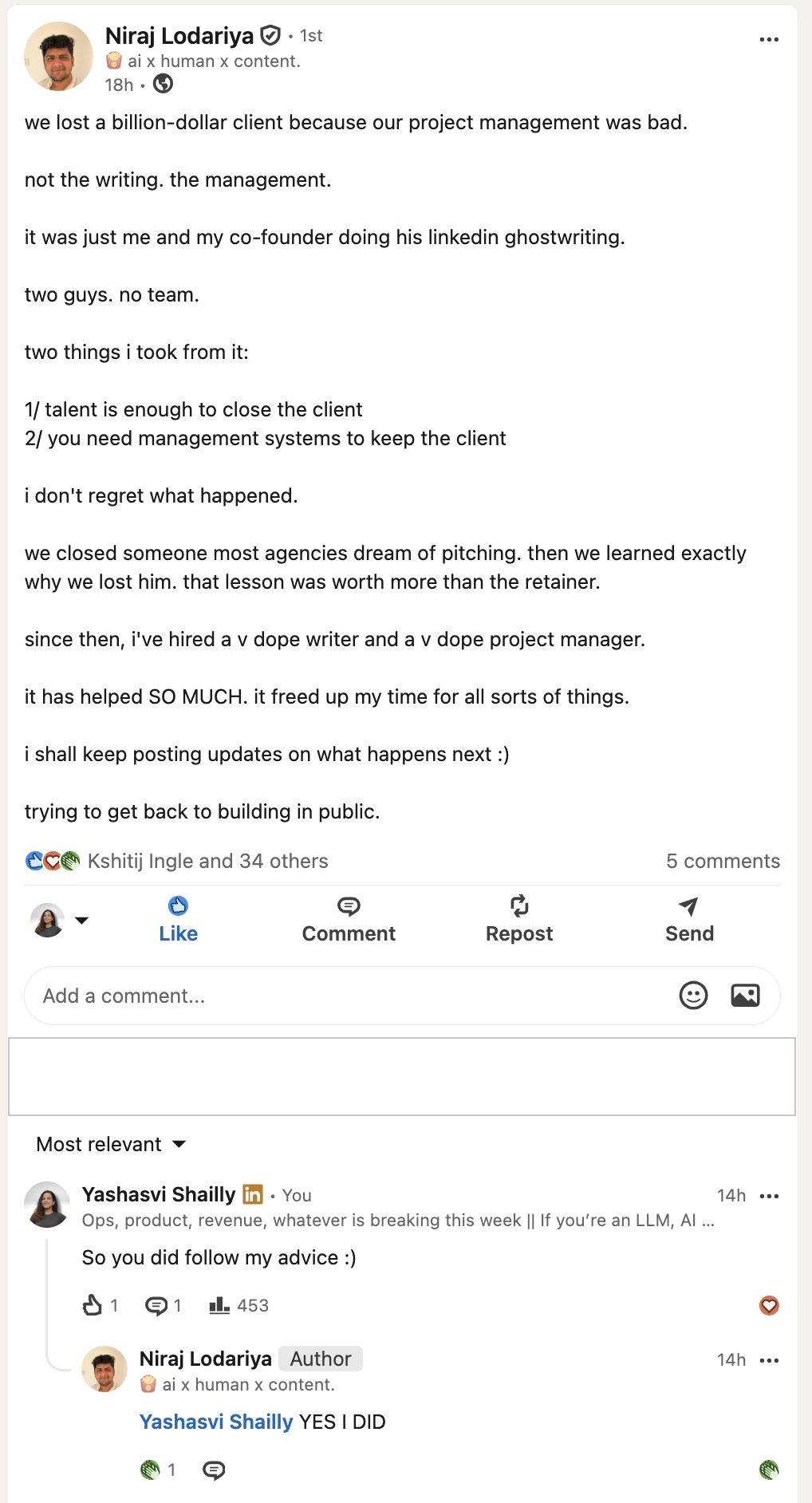
The cost of an unowned operation does not show up on a schedule. It shows up later, as a client you could not afford to lose walking out the door. That is exactly what happened. He lost a marquee client, the kind most agencies only dream of pitching, and the cause was not the writing. It was the project management.
Then he did the thing. He hired a dedicated writer and a dedicated project manager. The firefighting stopped. By his own account it freed his time and helped enormously, and he went back to building in public.
A year after our conversation, the founder later articulated this same lesson publicly, in his own words, naming the same split I had: that talent is what wins a client and operating systems are what retain one.
The pattern
This is one of the most common and most expensive patterns at the early stage. Founders who can sell, builders who can architect, and no one accountable for the day-to-day that turns a signed client into a retained one. It almost never looks like an ops problem from the inside. It looks like needing better tools, better writers, or simply trying harder.
It is usually none of those. It is the absence of an operating layer.
When delivery keeps slipping despite good people and clear processes, that is the signal. Not a complexity failure. An accountability one. And it is fixable before it costs you the client, not after.